

EU-Mercosur Is Live. Why This Matters for Brands That Want to Sell in Europe
Since 1 May 2026, the EU-Mercosur Interim Trade Agreement has been applying provisionally. For brands in Argentina, Brazil, Paraguay and Uruguay, that is more than policy news. It changes the commercial picture for entering Europe and, for some product categories, it can change it quite a lot. Preferential tariffs are now available for qualifying goods, and the wider framework for trade between both regions has become clearer. To use those benefits, importers still need to comply with the agreement’s rules of origin and submit a statement on origin to customs.
The opportunity is easy to understand. Europe’s single market brings together around 450 million consumers, and the EU customs union allows goods imported from outside the EU to move freely between member states without customs once they have entered the Union. That means the discussion is no longer only about whether a Mercosur brand can sell in Europe. (European Commission)
The real question is whether it can build a setup inside the EU that makes growth practical, fast and financially sensible.
Where the agreement can make a real difference
Not every product category benefits in the same way. Some categories were already low-duty or zero-duty. Others can see a meaningful reduction in import costs if the goods qualify for preferential treatment under the new agreement. That matters because import duty is one of the first things that influences margin, pricing and the decision whether Europe is worth the effort. (Taxation and Customs Union)
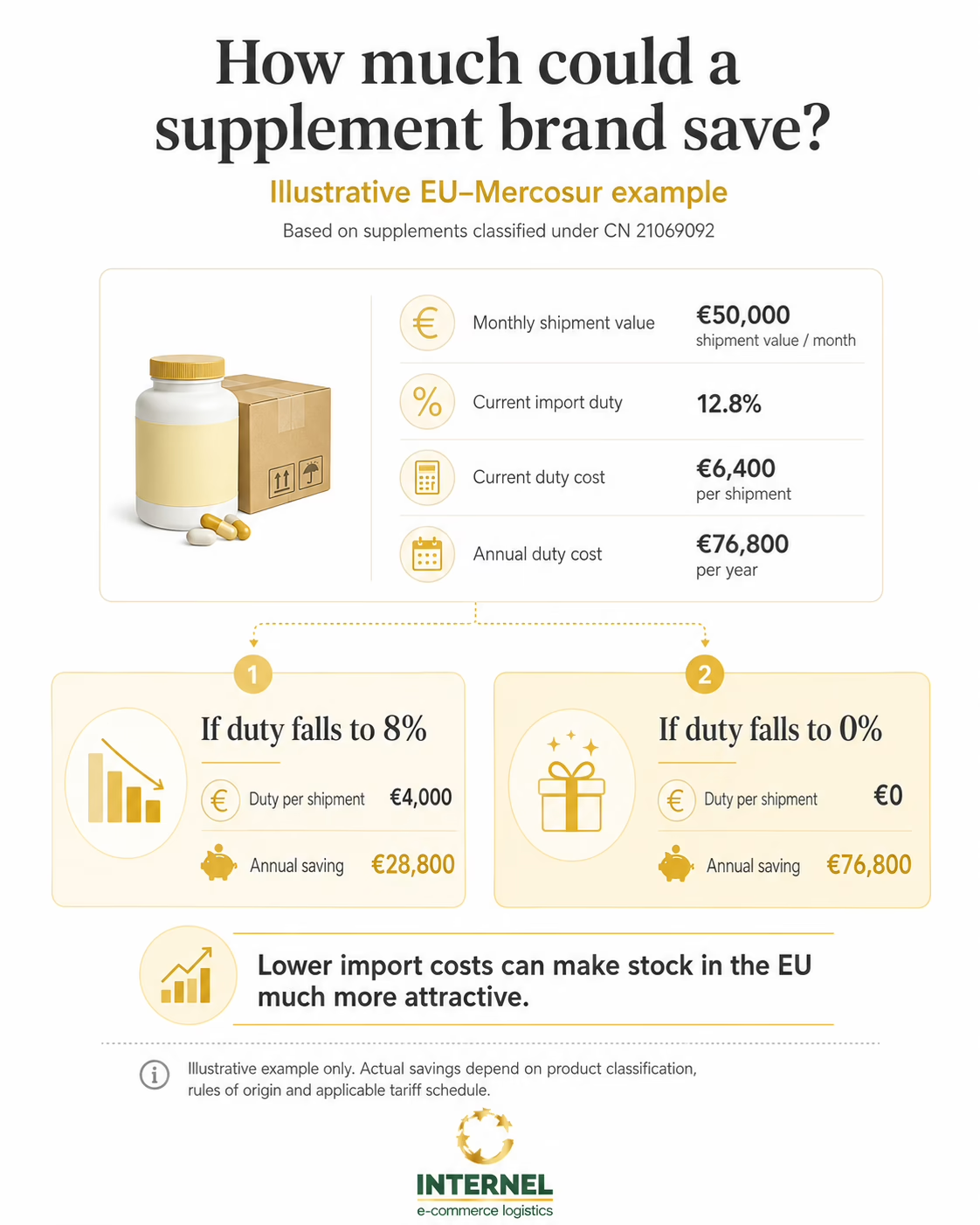
A good example is supplements. In one recent Court of Justice of the European Union case, products classified under CN 21069092 were associated with an EU customs duty of 12.8%. On a shipment with a customs value of EUR 50,000, that means EUR 6,400 in duty. Across 12 similar shipments a year, that becomes EUR 76,800. Even if the new agreement does not take the duty all the way to zero immediately, a partial reduction can still change the economics of the business very quickly. A drop from 12.8% to 8%, for example, would reduce duty on that EUR 50,000 shipment from EUR 6,400 to EUR 4,000, saving EUR 2,400 per shipment or EUR 28,800 a year. (GA-Alliance)
Fashion can also be a meaningful example. In European Commission customs guidance, a scenario involving 20,000 shirts uses a 12% import duty, with a customs debt calculated as EUR 19,200 on a customs value of EUR 160,000. That is a useful reminder that for apparel, duty is not theoretical. It can be large enough to shape pricing, stock strategy and the decision whether to keep shipping into Europe in small flows or to move inventory into the EU and scale more seriously from there.
Why beauty brands should still pay attention, even when tariff savings are smaller
Beauty is slightly different. For some cosmetic lines, customs duty is already low or even zero. Access2Markets shows a 0% third-country duty for some products under code 3304.99, which includes certain beauty and skin-care preparations. So, for a Brazilian hair-care or keratin brand, the strongest argument is not always “you will save a lot on duty.” In many cases, the stronger argument is that the agreement makes Europe look more realistic as a growth market, while the operational side still needs to be solved properly. (trade.ec.europa.eu)
That matters because cosmetics entering the EU still need to meet European product requirements, and Europe is not a market where brands can improvise. A beauty brand may discover that tariff savings are not the main story, but faster delivery, easier returns, better stock availability and a stronger local customer experience are. Once Europe becomes commercially attractive enough, the next move is not political but it is more operational. (trade.ec.europa.eu)
Why having stock inside the EU changes the game
For Mercosur brands, the difference between shipping into Europe occasionally and building a real presence in Europe is often a stock decision.
If products continue to be sent in small flows from outside the EU, delivery times stay longer, returns stay more complex and the whole model remains harder to scale. Once stock is placed inside the EU, the business starts to behave differently. Orders can be fulfilled faster. Multiple EU markets can be served from one setup. Returns become easier to manage. Inventory can be controlled in one place. The business stops treating Europe as a remote export destination and starts treating it as an active sales market. That is exactly where the EU customs union becomes commercially useful in day-to-day operations. (Consilium)
Poland is especially relevant here. For many cross-border e-commerce businesses, a fulfilment centre in Poland can act as a central hub for Germany, France, Italy and other EU markets. INTERNEL itself describes Poland this way and positions its setup as a practical base for managing stock and orders in one consistent system. For a Mercosur brand, that can mean a more efficient route into Europe than trying to build fragmented stock across several countries too early. (3PL POLAND)
Why Poland, and why INTERNEL
A Mercosur brand entering Europe does not only need warehouse space. It needs a partner that understands how the European market actually behaves.
INTERNEL’s position here is practical rather than abstract. The company already works in European e-commerce logistics, knows how brands expand across EU markets, and operates from Poland, which is strategically strong for cross-border distribution inside Europe. INTERNEL also positions itself as the only plastic-free 3PL provider in the CEE region, with orders leaving the warehouse in eco-friendly packaging. That matters more than it may seem at first glance. (Environment)
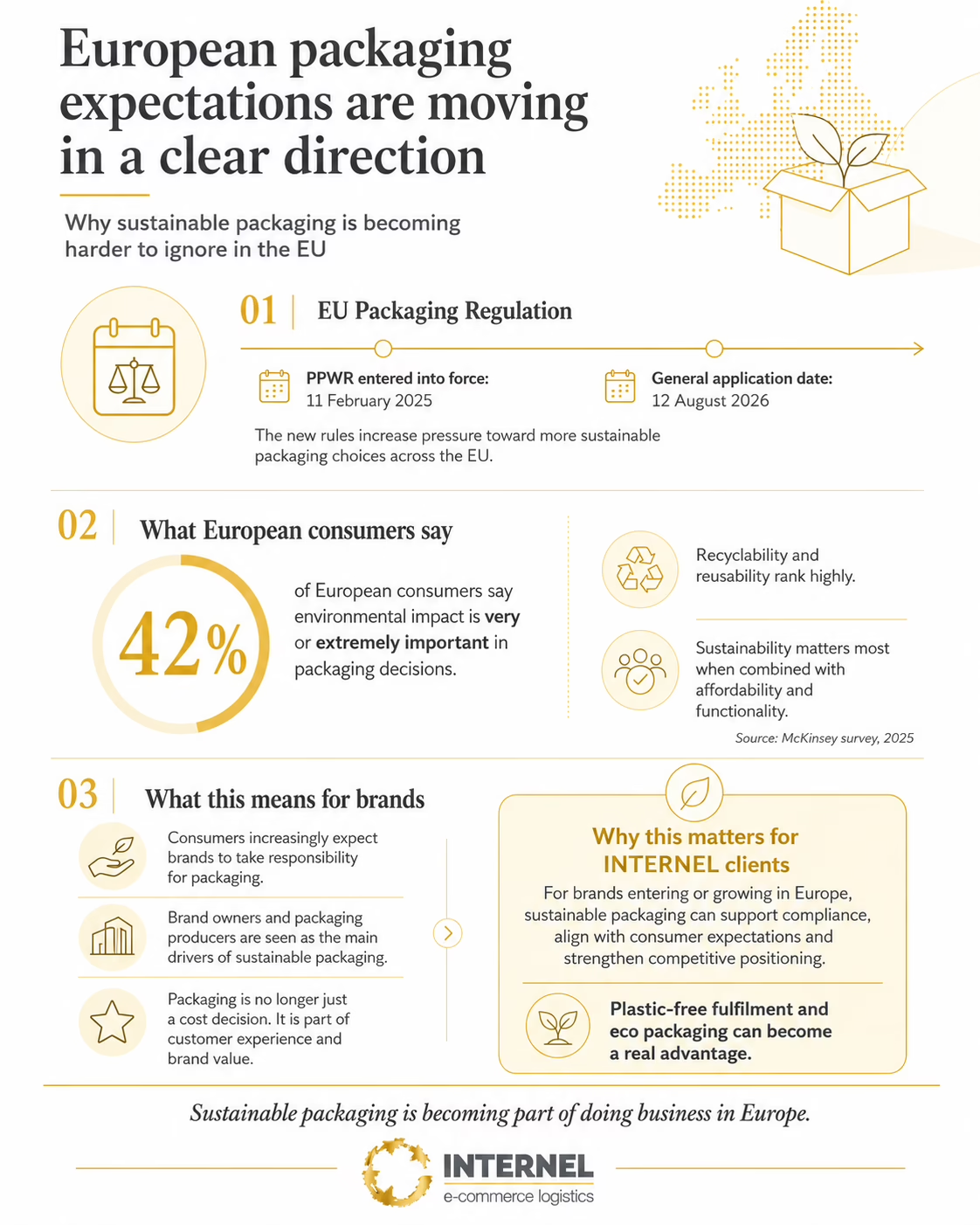
European packaging expectations are moving in a clear direction. The EU’s Packaging and Packaging Waste Regulation entered into force in February 2025 and will generally apply from 12 August 2026, adding another layer of pressure toward more sustainable packaging choices. At the same time, consumer research in Europe shows that sustainability still matters, especially when combined with affordability and functionality. McKinsey’s 2025 survey found that 42% of European consumers rated environmental impact as very or extremely important in packaging decisions, and that circularity factors such as recyclability and reusability ranked highly. In the same research, consumers overwhelmingly placed responsibility for sustainable packaging on brand owners and packaging producers. (Mckinsey survey 2025)
That creates a useful edge for Mercosur brands, especially in beauty, supplements and selected lifestyle categories. If a brand can enter Europe with stock inside the EU and also ship in a genuinely plastic-free format, that is no longer just a logistics decision. It becomes part of the brand offer. INTERNEL´s own packaging positioning is built around exactly that: no plastic, better fit-for-product packaging and a cleaner unboxing experience that aligns better with what many European consumers already expect.
The commercial logic is straightforward
🔹For supplements, the agreement can improve margin.
🔹For fashion, it can take a meaningful customs cost out of the equation.
🔹For beauty, it may not always be about duty, but it can still make Europe a more attractive next step.
In all three cases, the conclusion is similar. Once entering Europe starts to make commercial sense, having stock inside the EU becomes a serious advantage. That is what shortens delivery time, simplifies returns, supports cross-border sales and creates a more stable base for growth. (GA-Alliance)
From market access to market presence
The EU-Mercosur agreement opens the door. It does not build the operation behind that door.
Brands still need the right import setup, the right fulfilment structure, the right packaging choices and the right logistics partner inside the EU. For Mercosur companies that want to move from exporting into Europe to actually building a European sales base, that is where the real work starts.
And that is also where the right 3PL partner in Poland can make the difference between interest in Europe and a business that actually works there. (Taxation and Customs Union)
For Mercosur brands, the opportunity is clear. Lower barriers can improve the business case for entering Europe, but the real advantage comes when that opportunity is backed by stock inside the EU, reliable fulfilment and packaging that fits European market expectations.
If you are looking for a practical way to turn EU market access into day-to-day operations, get in touch with INTERNEL.
