

Poland is not cheaper. So why are e-shops moving their fulfilment there?
If you are selling across multiple EU countries and handling a few hundred to several thousand orders per month, the idea of fulfilment Poland will probably come up sooner or later.
At this stage, logistics usually starts to feel different. What used to work in one market becomes harder to manage across several. Shipping costs become less predictable, delivery performance varies and returns start taking more time and attention than expected.
Most teams initially try to optimise individual parts. Only later do they realise that the issue is often structural.
So, the real question is not whether to use a 3PL, but whether your current setup still makes sense.
Is fulfilment in Poland the right choice for your e-commerce business?
Before going further, it helps to say one thing clearly.
A Poland fulfilment centre is not the best option in every case.
If most of your orders are concentrated in one country, local fulfilment will usually be faster and sometimes cheaper. Shipping from Poland to Spain will not outperform a Spanish or French setup in terms of distance.
However, many growing e-commerce brands are no longer operating in one market. They sell across several EU countries at the same time. And that is where the situation changes.
What usually breaks first: not shipping, but structure
We often speak with brands that have their stock split across two or three countries, for example Germany, Italy and occasionally another local warehouse.
On paper, this looks efficient. In practice, it creates friction.
Typical issues include:
- inventory imbalances between countries
- duplicate stock and tied-up cash
- different processes in each warehouse
- inconsistent handling of returns
As volumes grow, teams spend more time coordinating operations than improving them.
This is usually the point where centralisation starts to make sense.
What changes when you centralise fulfilment in Poland
Working with a single Poland fulfilment centre changes the way your operations behave.
Instead of managing multiple stock pools, you operate from one central inventory. This reduces situations where one country is overstocked while another runs out.
Processes become more consistent and integrations simpler. More importantly, you gain a clearer overview of your stock and operations.
Shipping distances may increase for some destinations. However, the overall system often becomes more predictable and easier to manage.
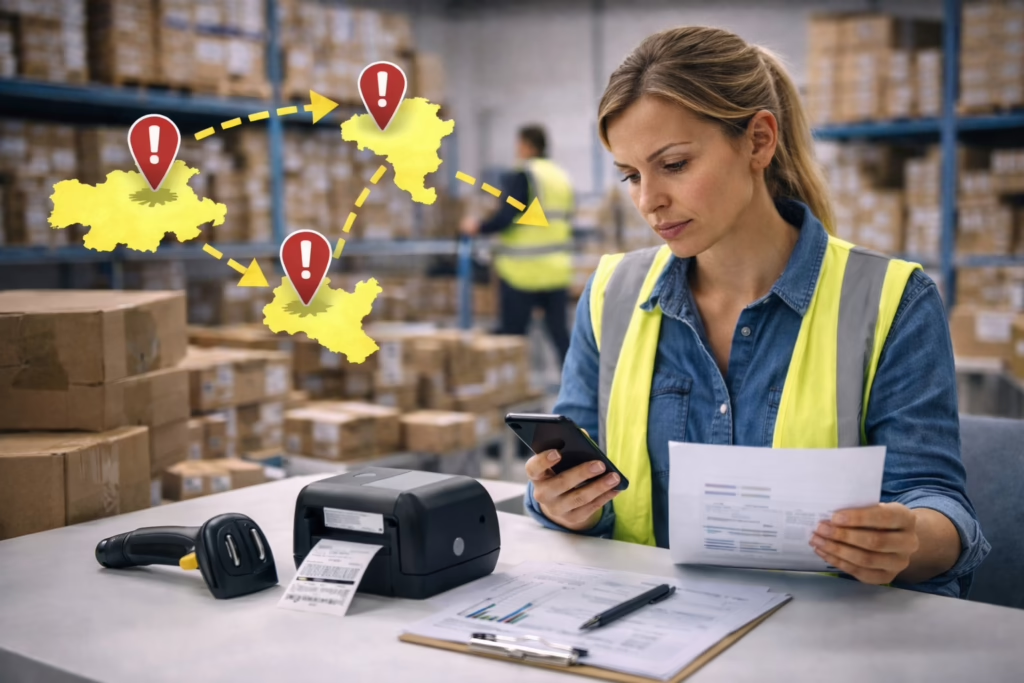
Returns are where most setups quietly lose money
Returns are rarely modelled properly, yet they have a direct impact on both availability and cash flow.
In many multi-warehouse setups, returned products sit outside of sellable stock for days or even weeks. They move between locations, wait for processing or simply get delayed.
This creates hidden costs:
- products that cannot be resold in time
- stock inaccuracies
- unnecessary internal transfers
When returns from multiple countries are consolidated in one place, processing becomes faster and inventory becomes available again sooner.
In practice, this is one of the strongest arguments for fulfilment Poland, especially for categories like supplements, cosmetics or electronics.
Why carrier mix often matters more than distance
Shipping cost is not defined only by kilometres. It is heavily influenced by how your fulfilment partner works with carriers.
A well-structured 3PL in Poland typically uses a mix of regional and international couriers and selects routes depending on destination.
This means:
- competitive shipping to nearby markets such as Germany or Czech Republic
- flexible routing for different EU countries
- the ability to optimise cost vs delivery time
Most comparisons focus only on distance or a single carrier rate. In reality, the carrier setup often has a bigger impact on total cost.
When a Poland fulfilment centre makes sense
A fulfilment partner in Poland is usually a good fit if:
- you sell across multiple EU countries
- your products are small, standardised and easy to ship
- your operations feel increasingly complex
- returns already represent a noticeable part of your volume
It is less suitable if your business depends on one core market with very fast local delivery requirements.
A simple way to think about the decision
If most of your orders come from one country, staying local is usually the better option.
If your sales are spread across several markets and your operations feel heavier than your growth, centralising fulfilment often brings more control.
Final perspective
Choosing a fulfilment location is not about finding a perfect country. It is about building a structure that supports your growth without adding unnecessary complexity.
Poland appears frequently in this discussion because it offers a combination of operational capability, central location and flexibility.
For many e-commerce brands, that combination results in a simpler and more manageable system.
If you are considering fulfilment in Poland and want to understand whether it fits your current setup, we can look at your operations and give you a clear answer based on your real data.
💡 Read also our blog post: